
A holiday retrospective
Taking a break and looking back -- and forward


We hope that your holiday season has been full of joy and rest. This week we are taking a break from regular content to partake in some of that joy and rest ourselves, and since Monday falls almost exactly halfway between Christmas and New Years Day this year, this week we present a year-end retrospective and a look ahead to 2026.
It was an eventful year for higher education and for alternative grading. Let’s look at three trends we saw here at Grading For Growth.
AI enters the chat
Generative AI went from being a technology on the edge of the radar screen for many instructors, to an unavoidable fact of academic life in 2025. That was reflected in three of the most-read posts at the blog this year:
Robert wrote about grappling with how to redesign assessment and grading in his Discrete Structures class, based on AI issues in a late 2024 class, at this post:

After the course was done, he wrote this postmortem:

David wrote about his response to AI and how he’s changed his assessment and grading, in this post:

It’s safe to say that the conversation about artificial intelligence in higher education is far from over. We believe alternative grading has much to contribute here, and you can expect more analysis from us and our guest authors in 2026.
Our guest authors continued to be awesome
Speaking of guest authors: We started featuring posts from guest authors twice a month in 2024. The fact that we’ve managed to continue that pace of guest authorship is a testament both to how widespread the use of alternative grading has become and how generous its users have been in sharing their experiences. Here are three of the most-read guest posts from 2025:
Sarah Hanusch wrote this article about four issues with giving feedback to students and what to do about them:

Jordan Freitas shared a useful framework for thinking about the psychology of giving and receiving grades, the “Drama Triangle”:

And in a first for this blog, we featured a student guest author: Lance Markowitz, an undergraduate at Oakland University, shared what it’s like as a student to experience an alternatively graded course:

We have guest authors on the schedule through July 2026, but we are looking for new articles for the second half of the year. If you’re using alternative grading in your classes (or if you’re a student experiencing it) and you’d like to share your successes, failures, questions, and anything else — don’t be shy! Use the Guest Author Interest form to give us your “pitch” and we’ll get back to you soon.
Back to basics
Interest in alternative grading seems to be picking up momentum. To aid in understanding what alt-grading is all about, we wrote a few articles in 2025 that addressed some of its foundational ideas. Some of these were among the most widely read articles of the year.
David did a thorough study of one of our most fundamental examples of the flaws in traditional grading: The story of Alice and Bob.

We have written lots about The Four Pillars framework for alternative grading, but never an article devoted to it. Robert fixed that here:

Finally, David addressed some of the most common “knee jerk reactions” to alternative grading here:

The year that was, and the year ahead
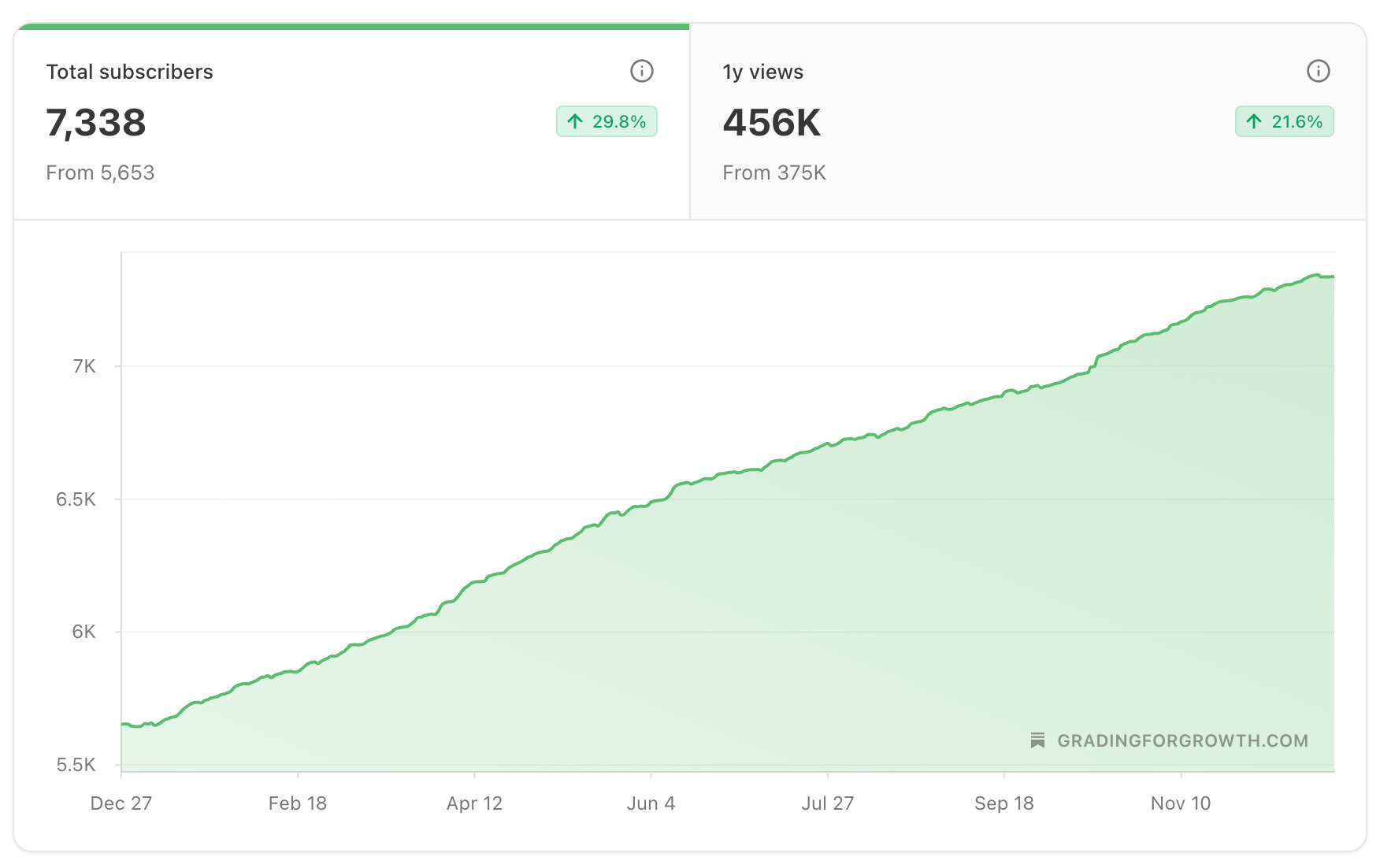
In 2025, Grading For Growth enjoyed a 29.8% increase in subscribers and a 21.6% increase in overall views compared to this time in 2024. That’s over 1600 new subscribers!
We appreciate every one of you reading the blog. We know attention is a scarce resource, and it means the world to us that you are spending some of yours here.
This blog is and will remain free — we make no money from it. If you’d like to support us, you could purchase a copy of the Grading for Growth book and start a book club (or convince your college’s teaching/learning center) to read and discuss it!
Robert was recently asked in an interview if higher education was on the cusp of a revolution in how grading was done. His response was No — we’re not “on the cusp”, we are well over the edge and the revolution is currently underway, through the everyday actions of instructors in the classroom making alternative grading happen. We fully expect this revolution to pick up considerable steam in 2026, as alt-grading seems to be at the intersection of many disruptive forces currently shaping education. And we’ll be here for it, with posts every Monday without fail. We look forward to the ride and having you along for it.
A perfect time to pause, reflect, and smile 😄✨