


Just before our spring break, I had a busy week of grading in my Calculus 2 class. I took notes each day on what I was doing and thinking around grades each day, and in today’s post I’ll share those notes with you. I hope you enjoy this on-the-ground insight into my grading decisions. These practical details are inextricably tied up with my own philosophy as well, so we’ll veer from the nitty-gritty details of midterm grades to my big-picture thoughts about building trust.
A little more about Calculus 2: This is a freshman- and sophomore-level class that serves a wide variety of majors, although because of when and where my section is offered, about 90% of my 30 students are Engineering majors.1 My class uses a mixture of standards-based grading and specifications. We have a quiz or exam every two weeks that assess students on a list of recent standards called “learning targets”. Students earn a mark on each learning target. During the alternate weeks, students complete advanced written assignments that I call “homework” and which are graded holistically using specifications, meaning that students earn one overall mark on the entire homework assignment. If you’d like to know a bit more, I wrote about a previous version of the class here: Updating an alternative grading system after a 6 year break.
Monday: Midterm grades
Today was the deadline to enter midterm grades. “How do I assign midterm grades?” is a big question when you’re using alternative grading, so I’m going to share my process.
I use a grade table to describe each letter grade. Here’s how final grades are assigned, where “S” refers to the Successful mark. Students must complete all of the items listed next to a letter grade in order to earn it:
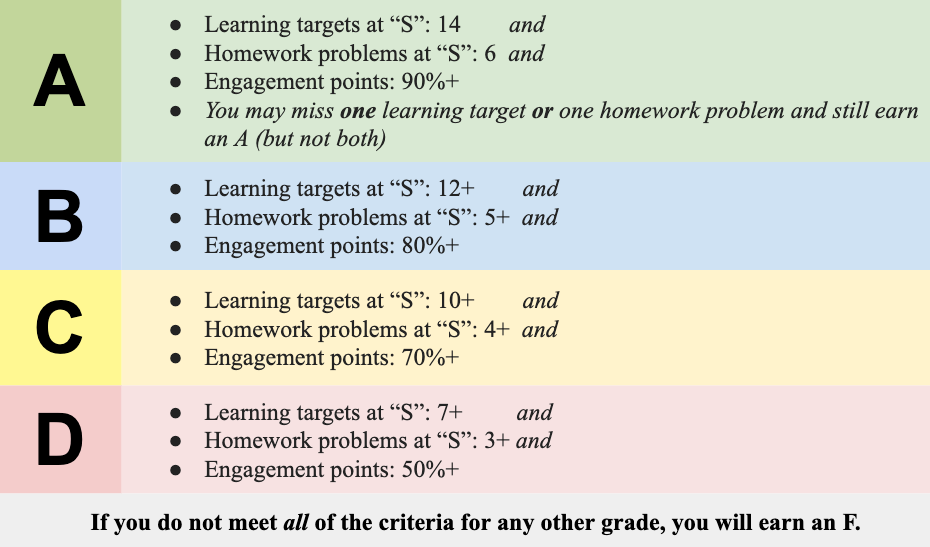
Of course, if I used those requirements here in week 7 (of 14), everyone would have a D or F.2
Instead, I created a similar list of requirements based on how many learning targets and homeworks we’ve finished so far (which is almost exactly half: 6 targets, 3 homeworks). I deliberately added some wiggle room to this list, because students still have lots of time to retake and revise:
A: targets at S = 5 or 6; homework at S = 2 or 3; engagement points = 90%+
B: targets at S = 4 or 5; homework at S = 2; engagement points = 80%+
C: targets at S = 3 or 4; homework at S = 1 or 2; engagement points = 70%+
D: targets at S = 1 or 2; homework at S = 1; engagement points = 50%+
F: targets at S = 1 or 0; homework at S = 0; engagement points: less than 50%
Then I determined which category each student’s current work best fit into, and used that to assign midterm grades. I also shared this list with students. Inevitably some students didn’t fit into one category, in which case I made a professional judgment. Criteria for that judgment included: Has the student been taking advantage of new attempts (for learning targets) and revisions (for homeworks)? If yes I erred on the higher side. Has the student missed a significant number of engagement-related items that correlate with success (like attendance, daily prep, or autograded homework)? If so, I erred in the lower direction.
I also added a personalized comment in our LMS gradebook to explain any special cases, always including concrete advice and words of encouragement.
What this approach to midterm grades does best is answer the question: “Am I on track?” or in more words, “Is what I’m doing good enough to earn the grade I want?” I emphasize to students that this midterm grade is just an estimate – it’s not a promise and it’s not inevitable. If they’re happy with this estimate, they can continue doing what they’ve been doing. If not, I ask them to come to an office hour to make a concrete plan. I also make it very clear that they do have time to change course and earn a higher grade, if that’s what they’d like to do.
If you want to read a lot more, check out my previous post on midterm grades.
Tuesday: Learning Target Explanations
We have an exam later this week, which means students will be assessed on some new learning targets. A big question, both for students and for me, is “what does it mean to meet a learning target (a.k.a. standard)?” In this class, there can be quite a lot of details to attend to, even in a single relatively small target.
Long ago, I started taking detailed notes about what matters most on each target, and also common mistakes. I quickly realized that I should share these notes with students as a way to clarify my expectations. I talk about these expectations as we learn about the new target in class, but that’s a lot to take in all at once, so having a written reference helps. Since then, that list has evolved into a “Learning Target Explanations” list. I make this available to students from day 1, and encourage them to use it for studying purposes — much of it is written in the form of reminders about things we’ve discussed in class.
Today, I updated the explanation for our next learning target. Doing this kind of update is a fairly short process now that the initial writing is done.
Here’s one example. My very first learning target is:
I.1: I can construct an accurate graph of the antiderivative of a function, including select points, increasing/decreasing, and concavity. (Section 5.1)
Short and sweet, right? But what does that target really mean, in a practical on-the-exam kind of way? Here’s the Learning Target Explanation entry for it:
You’ll be given a function and asked to draw its antiderivative. That means you’ve been given the derivative of the final result. So, use the given derivative to find intervals of increasing/decreasing/etc. in the antiderivative (this part is a Calculus 1 topic). You might be given an integral function as well.
Things to pay special attention to:
Calculate an appropriate area under a given curve exactly, using geometric shapes to help (such as areas of triangles and rectangles). Sometimes I might give you the areas, especially for irregular shapes.
Account for “net signed area” by attending to areas above vs. below the x-axis.
Be careful if you’re given an integral function for which you might get “backwards” limits of integration. Write out an equation that represents the result – don’t try to track it in your head.
Use the Total Change Theorem to find exact points.
Figure out where the antiderivative equals zero. This might be given, or else calculate that point yourself if given an integral function.
Review everything you can from Calc 1 regarding what the derivative tells you about the shape of a curve. Much of this is covered first in Section 1.5 and then in Chapter 3. In particular, be ready to identify and explain how the derivative tells you where the antiderivative is increasing, decreasing, concave up, concave down, linear, and has a local maximum or minimum.
Draw each part of the graph carefully. Mark specific points that you’ve calculated exactly and make sure your graph goes through them. If a line should be straight, or curved in a certain way (e.g. concave up or down), draw that as clearly as possible. Give yourself a lot of space, and a large scale, to draw well. An ambiguous or hard to read graph could result in not meeting the target.
Remove the word “it” from your explanations! Use the name of the antiderivative and derivative functions. For example: “Because f is positive on (0,1), F is increasing.”
I also provide a list of practice problems from our textbook, with links (we use Active Calculus, which is free, online, and excellent.) Together with the class slides and activities that I post on our LMS, this document is essentially a pre-made study guide for quizzes and exams.
This has been helpful for students, but also beneficial for me. For students, this provides some extra clarity on what matters in a standard, and reminders about what to study. For me, writing out these reminders has helped me stay consistent when grading, and clarified my own thinking about which things matter and which don’t.
Here’s some more information about what it means to meet a standard.
Wednesday: Being flexible about assessments
Today I was editing a future exam in Calculus 2.3 Each exam has about one page of questions per target. With six total targets to assess, the exam felt too full. Worse, I was certain that one of the learning targets was going to be a technical, annoying, detail-oriented pain to complete (and grade!).
After wrestling with this for a while, I decided to assess that target in a totally different way: with a worksheet in class. I already have a useful activity that directly addresses the target, and we’ll already be working on it in class in teams.
So, I’ll use that worksheet as an assessment. Specifically, students will work in teams on most of the worksheet (for about an hour), and then complete a few additional individual problems after a debrief (for another 30 minutes or so). They’ll have a chance to check in with each other, as a sort of built-in pre-assessment. I designed these additional problems to be easy to check quickly by eye. I’ll look over those individual problems on the fly during class time and immediately record a mark.
This isn’t a core target in my class, so I’ve already decided that I’m OK if it’s assessed in a less “rigorous” way. By removing this target from a timed exam, I give students more room to work on the other targets. The group work ensures that students have some practice, and the individual questions give me a little bit more confidence on individual student knowledge. Best of all, if a student shows some confusion, I can immediately ask a followup question to check their understanding. For students who are struggling, my plan is to offer a reattempt without penalty via a brief oral reassessment during office hours. But I also fully expect that most students will pass the activity (and therefore the target) on the first try.
My main takeaway is that it’s important not to get too committed to my overall class plan. I’m definitely the sort of person who wants to make a plan and then stick to it. That plan, made before this semester started, called for this target to be assessed on an exam—but on the ground, right now, it’s clear that I needed to make a change. Be ready to be flexible when the situation calls for it.
I’ll report back on how this works, but I am hopeful!
Thursday: The importance of relationships
Today is immediately before the Friday at the start of spring break, so I gave an exam. My class is 4 - 6 in the evening. Great professor move, right?
Rather than talking about the details of that exam, I want to mention something unexpected that I noticed. This exam was relatively short, and I gave students our whole 2-hour class block to work on it. Since I knew many students would finish early, I encouraged (but didn’t require) them to stay after completing the exam and work on their next homework. Despite being spring break eve, a large number of students actually did stay! Some worked on other class work, or revised a previous homework assignment. I got good questions and had time to talk individually with some students who needed advice.
What I really felt in that experience was that I’ve managed to establish some trusting relationships with this semester’s students.
Nothing beats having solid relationships with students. Not the best slides, the most innovative activities, the most alternative of grading systems. If students don’t trust you, none of the rest matters.
Building these relationships requires an intentional effort from me, and it’s felt like a slow process this semester. Having multiple snow days near the start didn’t help! There have been signs: I’ve started to see more traffic at office hours. Students are beginning to be more willing to chat with me before or after class. We’re near registration season, so they’ve asked me for class recommendations or advice on getting a math minor. I’ve heard a little bit more about their other classes, their spring break plans, their lives. Many of them stayed after the exam to work on an assignment not due for two weeks when they didn’t have to. These are all minor things, but they hint at a certain level of trust and a feeling of safety in my class.
How do I earn that trust? More than anything I try to be a trustworthy, honest, and straightforward instructor. I tell students, clearly and often, that I want them to succeed, and that I believe they can. I give feedback written in that spirit. I often let students in on my decision-making process and share my reasoning for why class policies work the way they do. I give occasional anonymous surveys, summarize the results, and make real changes if I think they’re warranted. I also do my best to be my honest self in class. I am, and always have been, a huge geek, and I don’t try to hide that. One recent class activity was based around my personal interest in historical copper mining in Michigan (yes, really). That activity actually drew several student comments thanking me for sharing such an interesting topic. I read those comments as meaning “we saw your enthusiasm shining through” or maybe “thanks for sharing a bit of yourself” rather than “We’re actually interested in the total weight of copper mined at the Quincy mine from 1880 through 1905.”
If students trust that you have their best interests at heart, they will be much more willing to take your advice, to listen to honest feedback, to believe you and act when you say “you need to change your approach to this class”. Trust is also a key element to making a successful alternative grading system: Students who trust you will be more willing to also trust that this weird grading system could actually be good for them.
If you’d like to read more, here an old post on the importance of trust and relationships.
Friday: Grading an exam
Today I graded the exam that I gave yesterday. Here are some thoughts about how I’ve arranged learning targets and exams in this class.
On exams, I assess learning targets via one page of questions each. Students earn one overall mark on that target, specifically: Successful, Revisable, or Needs New Attempt.
I’ve written about the Revisable mark many times, but here’s another chance for me to plug it. Essentially, a student who earns Revisable can come to an office hour, explain their mistake, show how to correct it, and then earn an automatic Successful. This is a great way to deal with minor errors or places where it doesn’t make sense to require a student to try a full set of new problems on the next exam.
Let’s not skip the main goal: earning Successful. In this class, I decided that students only need to earn Successful once per learning target in order to earn credit. (In other classes, I often require two Successfuls.) I did this in part because it simplifies the assessment schedule a lot. Students don’t need to spend nearly as much time on assessments and I don’t have to write as many. I already have a quiz or exam every two weeks; requiring two Successfuls would require weekly quizzes or much larger exams.4
However, I do think that it’s important to check on students’ understanding over time, and make sure they’ve retained essential knowledge. In Calculus 2, I do this by identifying five “core” targets. Students must re-attempt these on a required part of the final exam, to show their continued learning. Those attempts adjust the final grade up or down with a plus or minus. Those final attempts can also contribute to the student’s overall grade by counting as the one required Successful, if they still need it.
I’ve also settled on offering a total of three attempts on each target: Two during the semester, and one on the final exam. The two during the semester appear on the first quiz or exam after we’ve covered the material, and then the following quiz or exam two weeks later. After that, there are no more attempts until the final exam. As always, it doesn’t matter when a student earns Successful on each target, as long as they do.
I agree with Sharona Krinsky who often says that “three attempts is the perfect number”. Two attempts is too few to give students a chance to show learning and growth. But four or more attempts encourages students to not take those attempts seriously, and through years of observation, I’ve seen that students who are effectively studying rarely need four or more attempts (and those who aren’t effectively studying need an intervention!).
I also like that students have a first attempt to see how they’re doing, then a followup attempt that lets them correct any minor issues in the first attempt. If they aren’t ready by then, they have the entire rest of the semester to prepare, now knowing that this target is a tough one that they have to focus on. I say exactly this to students.
My class sessions are two hours long and I write exams to take at most one hour, but I offer the full two hours if needed. The goal is to make that time as low-stress as possible for a timed assessment.
In general, I’m pretty happy with all of these choices. They work well for my students and in my class, and I’ve intentionally set up my class to use these choices. Of course, there isn’t just one choice that works for everyone — if these don’t make sense for your situation, you can and should make a different choice!
Final thoughts
I enjoyed the exercise of intentionally reflecting on my day-to-day grading work for Calculus 2. You might enjoy doing something similar. If you do, please consider submitting a guest post proposal to share your reflections with our readers!
Calculus 2 is a required class for all Engineers at GVSU. My section of the course is the only one offered at our “City” campus, where our Engineering program is housed. It’s a late afternoon section, which is offered to avoid conflicts with many other Engineering classes.
This is something that’s both an advantage and a difficult part of alternative grading. In a traditional weighted percentage system, students have a “current grade” at each moment that essentially represents a percentage of the current assignments they’ve completed. It’s much more honest to show students the overall goals they need to meet in order to earn each grade. But the consequence of focusing on overall goals is that it’s harder to indicate a current grade.
This is not the exam students are taking this week, but rather the next one. March is a busy time of year for me due to advising work, so I’m trying to pre-write the next exam to save time in the future.
I’m using only in-class exams, as a way to handle potential AI use. But a consequence is that I’ve had to devote more class time to assessment than I did in the past.
I like this play-by-play grading reflection, David! It would be helpful to know how many students are in your Calculus 2 class, to give context to some of the strategies you employ and how feasible they may be for others. Thanks!
I’m drawn to your use of the final exam to address retention (I’m sure you and Robert have both discussed this before). Alas, we do not have +/- grades, so I can’t use it in that same way. Do you have any thoughts on how you might incorporate your final exam into the course grade if +/- grades were not an option?