
Standards-Based Grading Six Years Later
Evolution of SBG implementation in response to experience, technology and student reactions


Hilary Freeman is a non-tenure track instructor with over 20 years of experience teaching and coordinating first and second year mathematics courses at Colorado State University. About 6 years ago she learned about and implemented alternative grading approaches in a coordinated calculus course. She has been a grateful participant in a CSU Community of Practice centered around alternative grading techniques for the last 4 years.
Six years ago I took over coordination of a first semester calculus course at Colorado State University, a public land-grant research university. It’s a course required for majors including engineering, math and computer science. The calculus course is housed in the Mathematics department and serves 250 to 450 students each semester in sections ranging from 36 to 120 students. Small sections are mostly taught by graduate teaching assistants while larger sections are taught by nontenure-track teaching faculty. We are fortunate to have a “Calculus Center” which provides, among other resources, drop in tutoring for calculus students 5 days a week.
The Grading for Growth book included this course in Chapter 8 (p. 114) as an example of alternative grading in a coordinated course. I’d like to provide updates to the course that I’ve made over the previous 6 years. These changes include reducing complexity in the grading system design and assessment types as well as implementing and responding to technologies that are new to me and new to students. I’ve also experimented with a few things and have made changes based on how students reacted (or did not react).
Briefly, the current set up for the class involves 3 days a week of instruction (Monday, Tuesday and Wednesday) with Fridays typically reserved for assessments. Final grades are based on 23 standards, online homework, and participation. I will go into more detail about the changes I’ve made that led to this current setup below.
Grading Structure
As many other authors on this blog have discussed, simplification is crucial for success with alternative grading. I’ve reduced the number of standards from 30 to 23. I used to require up to 5 successful demonstrations to mark a standard as complete. I’ve cut that back to one to three successes needed, depending on the standard. This has reduced the number of times I need to assess (and grade) each standard. I think I still have some room to cut, with the goal of reducing student workload, teacher workload and class time spent on assessment rather than instruction.
Rubric options have gone from Meets Expectations/In-Progress/Not Gradable to a 4 option EMNR type. However, many students receiving Ms would argue for Es and it was more work than I had bandwidth for to make sure all the graduate instructors were consistent so I settled on S/NY for Satisfactory and Not Yet. If I were teaching a single section course and it were small, I’d probably use a 4 option rubric. I’ve experimented with allowing minor revisions, banning them, and allowing them again. A minor revision allows a student to clarify their work, or fix small or notational issues, which forces them to correct minor mistakes without taking up a reassessment attempt.
The overall grading structure for the course is basically unchanged: there are three “buckets” for students to fill toward their grade, and the final grade is determined by the score in the lowest bucket. The buckets are: Standards (assessed on quizzes, homework, exams etc.), Online Homework (WeBWorK), and Participation. At one point I had these cutoffs for each grade level:
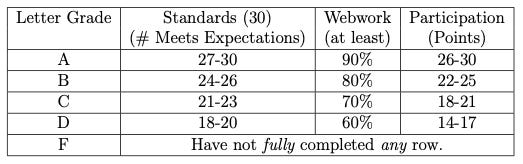
After having several students who nailed the content but had not reached an A level on online homework or participation, I felt like I was penalizing students for not doing practice they obviously didn’t need. Thus I reduced how much online homework and participation count:
To earn a D, students must complete at least 15 (out of 23) standards and score at least 60% on online homework and 60% on participation.
To earn a C, students must complete at least 17 standards and score at least 70% on online homework and 70% on participation.
To earn a B, students must complete at least 19 standards and score at least 70% on online homework and 70% on participation.
To earn an A, students must complete at least 22 standards and score at least 70% on online homework and 70% on participation.
This new grading scheme introduces more breathing room for the students and instructors. For example, if one part of an online homework problem is poorly worded, students can just skip it. Or, if a participation assignment is missed and not made up, it’s still possible to get an A.
Two lessons I learned from experimenting with online homework and participation:
First year students in general need to have a weekly assignment or they will ignore the “you must have 70% by the end of the semester,” so it is absolutely worth the time to enter weekly online homework assignments into the learning management system.
One semester I dropped the participation bucket and student attendance plummeted a lot more than I’d hoped. Additionally, allowing instructors to choose how they want to grade participation gives them skin in the game and helps them feel ownership of the course.
Assessing Competency on Standards
To assess standards, I have tried quizzes, practice quizzes, revision quizzes, reassessment quizzes, written homework, homework revisions, and live-assessments or evening exams. Sometimes students were doing multiple types of assessments in the same week. Some students would be surprised by the additional assessment, and grading two assessments in one week was not fun. This has all been simplified to effectively one quiz per week, although the quizzes come in several forms that I’ll describe next. Standards are typically assessed as one standard per question, with the question containing the standard text, such as “I can use the limit definition of the derivative to determine the differentiability of a function at a point.”
The four types of weekly “quizzes” are individual quizzes, group quizzes, evening exams, and reassessment quizzes.
Early in the semester there are few standards that we have taught, so individual quizzes are given in class and have 1-3 questions and take about 20-30 minutes. End of semester individual quizzes might have 5-6 questions and take the entire 50 minute class period. Group quizzes, described below, take the whole period and cover 2 standards. Exams (glorified quizzes) take place in the evening and last 2 hours, allowing us to test 6-7 standards. Every student tests over the same standards on the previous three types of assessment. For reassessment quizzes (in-class), students select up to three standards they need to reattempt, and get 30-35 minutes for those individualized quizzes, which are the only quizzes that week. The reassessment process is outlined in more detail later.
In addition to simplifying the number and types of assessments, I no longer use oral exams (called live assessments in the Grading for Growth book), which I really enjoyed. But because many instructors were new to teaching, they were difficult to implement fairly and consistently. I’ve reverted to traditional exams, which are given 3 times a semester in the evenings over a 2 hour block of time.
While I appreciate the benefits of written homework assignments (briefly re-named “take-home quizzes” to try to get students to take them more seriously), after grading too many AI generated solutions, I dropped the written homework component and now those weeks are “group quiz” weeks. Students get a packet that covers just two standards, with several questions for each standard.1 Students bring these packets to class on Friday and work in groups of 2-4. The first 20-30 minutes of class is peer grading of one question per standard. I pass out directions including a rubric to use and specific questions to focus on, such as “Does the answer you are grading have all the limit notation in every step?” For the last 20-30 minutes of class, students put all their materials away and I pass out a quiz with new but similar questions covering those same 2 standards. Students can work in their groups on the quizzes, but cannot use the internet, AI or other outside resources. For simpler questions, each student in the group has a slightly different question. For harder topics like optimization, each student has the same question. Quizzes are submitted and graded individually.
Replacing written homework with group quizzes is my current favorite change! I have had 50 minute classes of some of the best mathematical conversations going on between students, in addition to a much higher quality of work being submitted. Some students verbally requested more group quizzes, and when I solicited written reflections, group quizzes were described favorably. I didn’t want to force the group work on anyone, but only 2 students in my class of 36 requested to take their quizzes alone.
The first two group quizzes went really well with most students taking the preparation seriously. But by the third group quiz (covering optimization, one of the hardest topics in calculus 1), several students had not adequately prepared and I worried that the prepared students fell into teacher roles that might have negatively impacted their success on the quiz. I asked for feedback after that quiz though, and most students expressed a fair balance between “teaching” and “being taught”. I liked the peer grading component because it forced students to pay attention to what I considered important. Specifically, on the first quiz’s topic, students typically are very lax with their notation, dropping the limit notation, using “→” when they mean “=”, and making many algebra mistakes. The peer grading asked them to focus on the notation, and as I observed the groups, student conversations included pointing out where limit notation was dropped as well as algebra mistakes that were made. As expected, the group quizzes were submitted with much better notation and many fewer algebra mistakes. What surprised me though, was the work submitted on the exam (done individually) for the same standard was of much higher quality than previous semesters. I hope to refine this assessment and find ways to make sure students do take the preparation seriously as it doesn’t work well when too many students are unprepared.
Reassessments/Revisions
Given the coordinated nature of our course, I decided to have a very structured approach to reassessments and revisions. At first, I tried to do a reassessment each week over the previous week’s assessment. Initially I was using Canvas (our learning management system) for these weekly reassessments via (unproctored) quizzes. The complexity of yet another type of assessment/platform (as well as lack of enforcing resources used on quizzes) caused me to abandon this approach. I also moved away from weekly reassessment periods as they were overwhelming to keep track of for both students and instructors.
Next, reassessments became restricted to the same weeks that written homework was due, and only certain standards could be selected for each reassessment. In addition, mistakes made on written homework could be revised rather than triggering a reassessment. This was still too complicated and revisions vs. reassessments caused confusion.
The current approach allows for minor revisions and reassessment quizzes. Since we’ve removed written homework assignments, we no longer have homework revisions. I’m allowing “minor revisions” on quiz problems with a very strict and short deadline. Work eligible for a minor revision is marked Not Yet and feedback directs the student to find the mistake(s) and submit full corrections on paper by the next class. If the new work demonstrates competency, the grade is changed from NY to S. I need to better define minor revisions, but for now they are up to instructor discretion and should be used only in cases where we are fairly certain the student knows what they are doing but have some issues with how they communicated such as illegible handwriting or a transcription error. Personally, I ask myself “Should this student do a new problem or do they basically know what’s going on?” and “Do I have time to regrade and keep track of this minor revision?”.
Reassessment quizzes are given on select weeks during the semester, usually the week following an exam. During a reassessment week, students communicate which standards they want to reassess via an online survey. Students select up to 3 standards from a list of standards that are done, i.e. they won’t be tested on any future quizzes.2 Then I run a python script written for me that generates a unique quiz for each student. On Friday, each instructor hands out the individual quizzes and that is the assessment for the week. I have found that limiting students to only 3 standards increases their success and allows us to have the first half of class for instruction. In the past, when students were allowed to choose up to 5 standards and take the entire class period for testing, the students choosing 5 were usually not successful on any standards.
Students must do two things before they can take the reassessment quiz. First, they must get their online homework score up to 90% for the standard they are reassessing. (The online homework assignments are organized by standard, an idea I borrowed from a blog post!) Second, students must fill out a paper-based “Reassessment Request Form.” The point of this form is to encourage students to reflect on their mistakes and prepare differently rather than hoping that it will go better this time. The form asks students to articulate the mistake they made, correct the mistake, then work out a new problem. Even with a form, students were still being unsuccessful on reassessment quizzes, so we introduced a requirement for students to explain their work on the form to a tutor in the Calculus Center. To verify this conversation takes place, the tutor signs the form and the student submits the signed form to their instructor in class before they can receive their reassessment quiz. Ideally there would be time for more back and forth between the student and tutor, but in reality sometimes the tutors sign after only a quick check.
In the first iteration of the reassessment process, the Calculus Center became quickly overwhelmed, so I removed required visits until I could revise the process. We still have to watch for the center being too busy. I try to work on messaging so students go early in the week and early in the day when the center is less busy, but we still have issues. Reducing reassessment weeks to only 3 standards also helps a bit so students aren’t trying to get 5 signatures at once. I also provide “Reassessment Guides” for each standard. Ideally, students start there, find their mistake among the “favorite mistakes” addressed in the document, and then the Calculus center conversation is hopefully quick.
Rather than offering a cumulative final, the final exam is a final reassessment. Students can choose any standard from those offered on the last quiz in addition to 5 standards from earlier in the semester. There is a two hour window for the final. I do not require the signature forms for the final. Until fall of 2025 I used to give the final reassessment questions as Canvas quizzes so that grading would be efficient, but with AI browser integration providing answers to the quizzes, I’ve had to revert to paper quizzes. The questions are still more likely to be multiple choice or fill in the blank so grading is faster.3
Technology
Our learning management system is Canvas and even though Gradescope is integrated with the LMS, rubric data is not transferred. I use several scripts to move grade data between systems as well as to create my own external gradebook to see aggregate data and create progress reports. Every semester I hope there are no updates that break this very fragile system.
I also utilize Microsoft Mail Merge to send students progress reports to help them pay attention to the grading system and take advantage of the reassessment windows. Here is a sample email sent after our third exam:
This is a grade update for Math 160 that includes all grades up through the Module 12 exam (if you have not taken it yet, adjust the information below or wait for grades to come in).
The highest possible number of completed standards is 16.
You have 7 standards completed: L1, L2, L3, L4, D1, D2, D4
The following standards still need just one attempt: S3, D3, D5, D6, D7
Take a look at your progress over the last few weeks and decide if you are on track to keep improving, maintaining or not.
Remember the withdrawal deadline is tonight at midnight. If you are on financial aid, please speak with a financial aid advisor before withdrawing.
15 Standards are needed to pass the class, 17 to get a C, 19 for a B and 22 for an A. Use the tracking document online to map out potential pathways to your desired grade.
Please speak with your instructor if you have questions.
One semester I had two students who got into a bit of friendly competition to create an electronic grade tracking system. This spring I finally was able to adapt their spreadsheets into an excel version where students could check off standards as they get them and grade progress would be automatically calculated.
Looking Back, Looking Forward
Reducing the number of standards and number of times I ask students to be successful before a standard is complete means fewer quiz questions asked and answered (reduces student workload) and fewer quiz questions graded (reduces instructor workload). This frees up time to improve instruction, to better answer student questions, and otherwise improve the course. This trade off has been very helpful and I actually want to push a bit more in this direction and cut more standards and questions. My hesitation is tied to not being confident that one successful mark means a student is ready for the next topic or course, so I’ll need to think carefully about how to ask better questions and explore more how this reduction will impact grades and subsequent performance. For example, after Fall 2025 I looked at how reducing the number of successes required on a derivative shortcut standard would have changed the final grade outcomes, and when only 13 out of 250 or so students would move up a letter grade if I’d lowered the cutoff, it seemed silly to ask students to show me 3 times when 2 times got basically the same result.
The simplification to only requiring 70% for online homework and participation works well for me because it has enough teeth to get students to do the practice and engage, but there’s enough flexibility built in to allow for missed deadlines, missing class, etc.
While I don’t love that most assessments are timed quizzes and exams, it does help the students know what to expect and reduces time needed to train them to meet a variety of different obligations, as they already have to cope with multiple assessment types and online platforms between all their different courses. When the assessment types and timing are more predictable, the students can spend the time on content rather than following a complicated schedule.
When I first started implementing alternative grading (during a pandemic, with a brand new text book and doing the entire course at once), the workload was unsustainable. But now, with simplification, some workflow changes, and technological help, I feel like I can focus on the other parts of teaching and coordinating again. I feel good about where the class is currently, and I am glad to have freed up some bandwidth to make additional changes.
I need to improve the communication of the grading system to the students and help them buy in earlier in the semester. Students who previously earned B’s and C’s are more likely to earn A’s and B’s, but the number of students in the D, F, Withdraw range is still high. Also, I need to have a more robust system for recording and reporting grades to students.
Given all these challenges, I’m still convinced that I’m on the right track with alternative grading and love that this system is giving me a framework to support the student learning strategies that I value.
Previously, written homework assignments were printed packets of questions covering 6-7 standards that students had a week to work on, then submit in class on Friday. Because I’ve reduced the number of standards and number of required successes, I’m able to assess only 2 standards on a group quiz and not fall behind.
This restriction is there just to reduce overall workload. I’d prefer to allow reassessments on any standard that we have already tested at least once.
Originally I called the final BYOF for “Build Your Own Final” but this has been simplified to “final reassessment”, which also makes it more clear that there are no additional attempts if mistakes are made on the final.
 | A guest post by
|
Thank you for these thoughtful reflections. I don't use SBG, but I do a hybrid alternative grading system and it is useful to consider these same parameters for self-analysis.